Every hammer needs something to strike against. In a jeweller's workshop that something is usually small, heavy and very old in design: a block of hardened steel, or a little anvil, sitting on the end of a tree trunk.
Journal 17 · Atelier
Every hammer needs something to strike against. In a jeweller's workshop that something is usually small, heavy and very old in design: a block of hardened steel, or a little anvil, sitting on the end of a tree trunk.
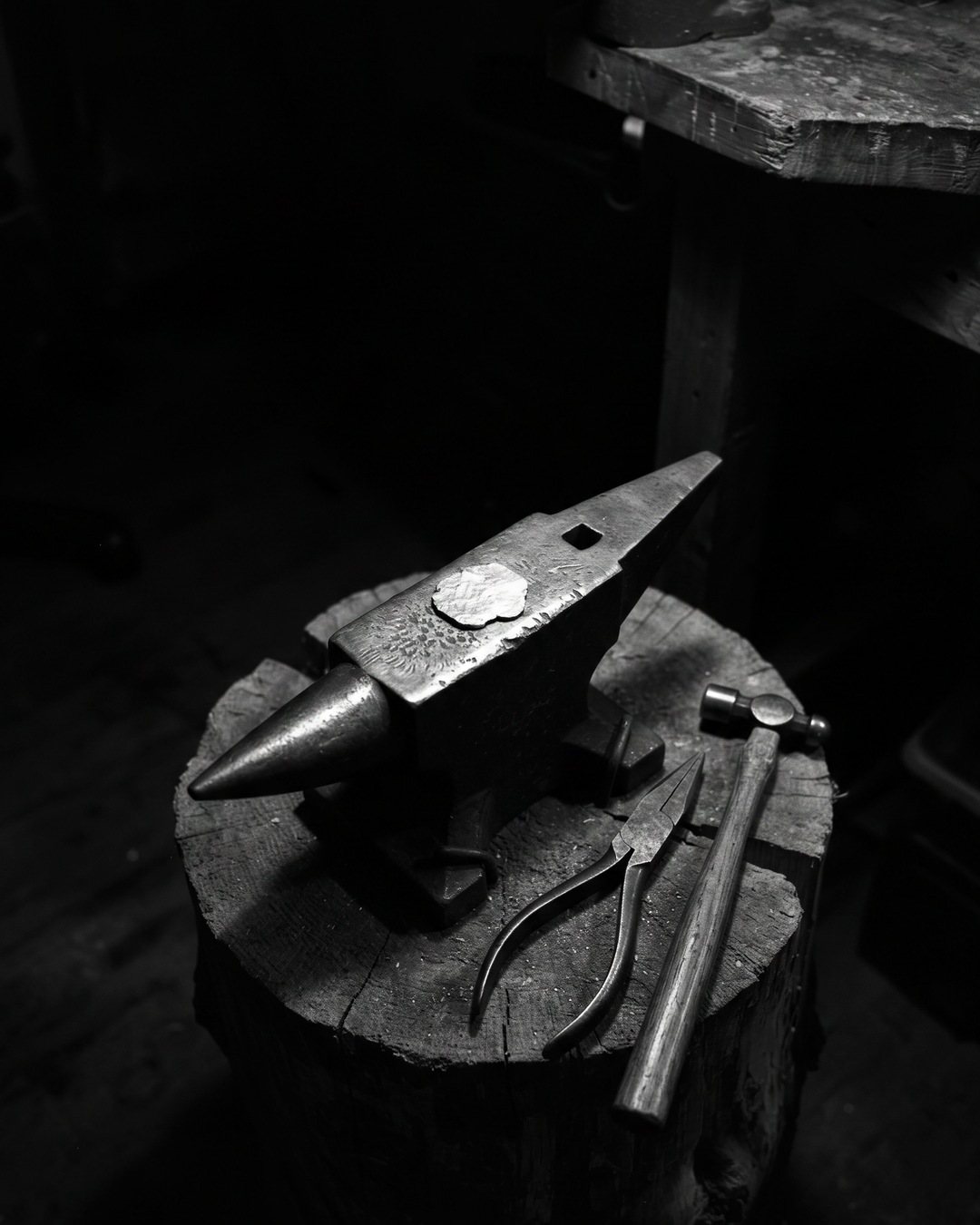
It looks rustic, almost accidental, but the stump is there for a reason. Wood absorbs the shock of the blow. Without it, every strike would travel through the bench and the floor, bouncing the anvil, rattling the tools and returning the energy to the hand. On a heavy piece of trunk, the blow is swallowed. The work stays where it is, and the sound becomes a dull, solid thud instead of a ring.
Smiths have worked this way for thousands of years. Long before steel benches and rubber mats, the simplest way to make an anvil sit still was to set it on wood. The stump in a jeweller's workshop is a small descendant of the blacksmith's, scaled down to the size of the work.
The face of a jeweller's anvil or bench block is kept smooth and polished, because anything on it will be printed into the silver: a scratch, a dent, a speck of dust. Some anvils have a horn — a rounded, tapered end — used to curve and form metal around it. Others have small holes and grooves to support the work while it is punched or shaped.
People notice the hammer, because it moves and makes the sound. The anvil does nothing visible. Yet it is half of every blow. The hardness of the steel beneath decides how much of the hammer's energy goes into the silver and how much is lost. A good anvil makes a light hammer work like a heavy one; a bad one wastes every strike.
In the photograph the anvil sits on its stump in the half-dark, a few filings around it, waiting. It will probably outlive everyone who has ever worked on it.