An atelier looks chaotic to a visitor and perfectly ordered to the person who works in it. The order is not visual. It is physical: everything is placed according to how often the hand needs it and how quickly it must be found.
Journal 09 · Atelier
An atelier looks chaotic to a visitor and perfectly ordered to the person who works in it. The order is not visual. It is physical: everything is placed according to how often the hand needs it and how quickly it must be found.
Think of the bench as the centre of three circles. In the first, within the reach of the forearm without moving the shoulders, lie the tools used every minute: the files of the day, the tweezers, a pair of pliers, the lens, the torch. They are never put away. They are put down, always in the same place, so that the hand finds them while the eyes stay on the work.
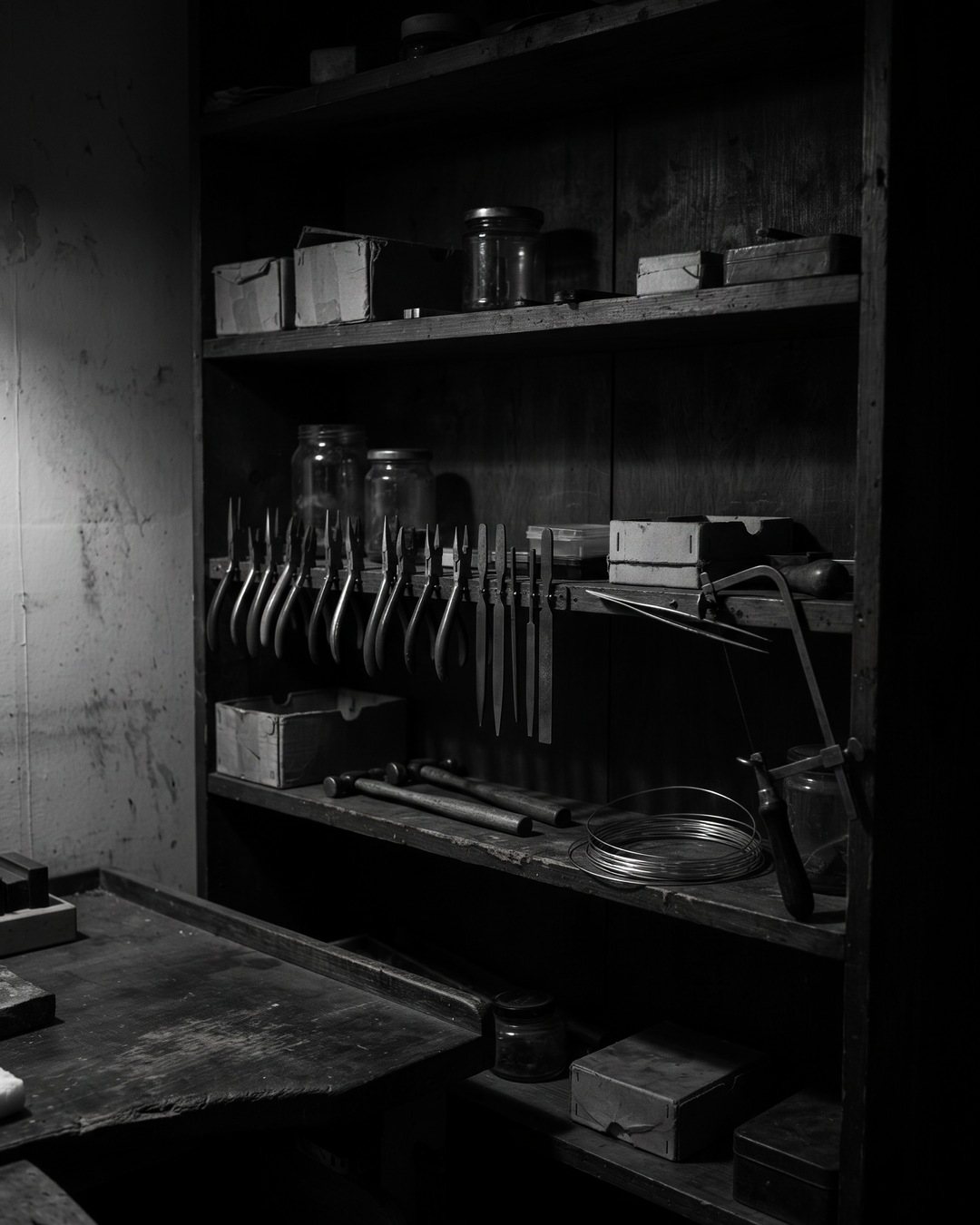
In the second circle, within reach of the arm, are the tools used every hour: more pliers, punches, mandrels for rings, a small hammer, the steel block. In the third — the shelves behind, as in the photograph — wait the things used every day or every week: boxes of wire and sheet, jars of liquids, rarely used pliers hanging in a row, spare files, the tools that are needed only for certain pieces.
Many moments at the bench are short. The metal is hot for a few seconds; a figure must be held in one exact position; a small part must be placed before the hand that holds the piece gets tired. When a tool is not where the hand expects it, that moment is lost. Losing it once is nothing. Losing it a hundred times a day is the difference between a piece that flows and a piece that fights you.
This is also why jewellers rarely like other people tidying their benches. To an outsider, a file lying across a pair of pliers is mess. To the person who left it there, it is a bookmark: it says where the last gesture ended and the next one begins.
The shelf in the photograph holds rows of pliers with handles hanging down, coils of silver wire, small boxes and jars. Each pair of pliers has its own job: flat jaws to grip without marking, round ones to bend curves, others to cut, to hold, to twist. Seen together, they look like instruments in an orchestra pit before a performance. Each one silent, each one waiting for the moment it will be needed.
Over years an atelier becomes a portrait of the person who works in it. The worn spots on the floor, the tools that are always within reach and the ones gathering dust say more about how the work is done than any description could.