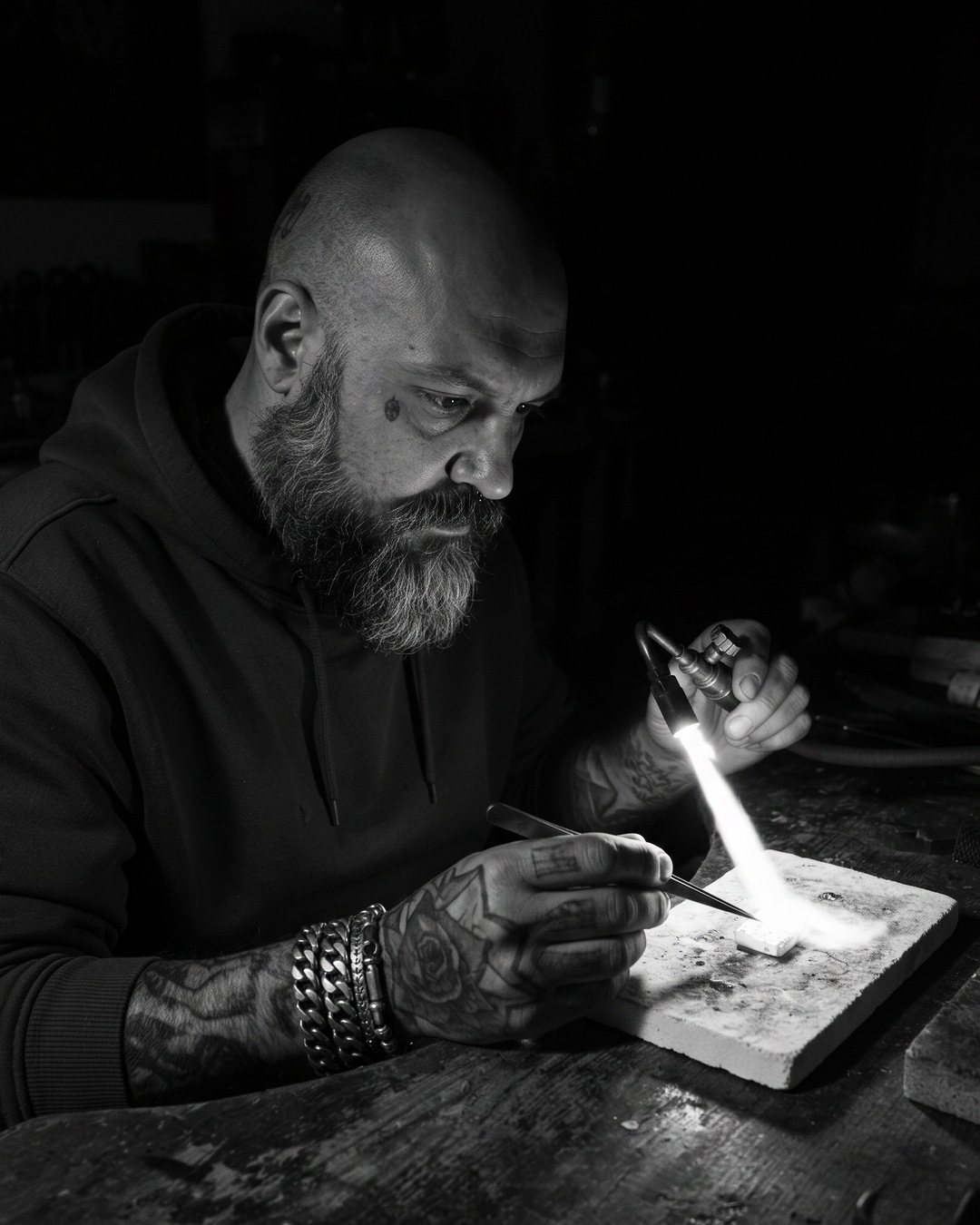
In most photographs of a workshop the maker is lit by a lamp. In this one he is lit by the work itself. The flame is the only light in the room, and for a moment the face and the metal share the same glow.
Journal 13 · Atelier
In most photographs of a workshop the maker is lit by a lamp. In this one he is lit by the work itself. The flame is the only light in the room, and for a moment the face and the metal share the same glow.
Heating silver is a matter of seeing colour. The metal does not announce its temperature; it shows it, quietly, through a shift from grey to a dull, deep pink. That pink is so faint that daylight erases it. This is why the torch is often used with the lamp switched off, the curtains drawn, the room reduced to the cone of the flame. In that darkness the eye becomes a thermometer.
There is also another reason. In darkness, attention narrows. Everything that is not the flame and the piece disappears: the shelves, the window, the phone, the day. What is left is a single question, asked again and again — is it ready yet?
The torch is held at a precise distance, never too close, never pointed at one spot for long. The flame moves in slow circles over the whole piece, so that thick and thin parts warm together. If one area runs ahead of the others, it can collapse before the rest is even warm. A small figure with thin arms and a thick body is the hardest of all: the arms want to melt while the body is still cold. The hand learns to favour the thick parts and only brush the thin ones.
The face in the photograph is calm. That calm is learned. Early on, every jeweller is nervous at the torch — the hiss, the heat, the speed with which silver can be lost. After years, the flame becomes a familiar instrument, closer to a brush than to a weapon. The concentration stays. The fear goes.
Then the torch is turned off, the room is dark for a second, and the lamp comes back on. The piece is still warm on the board, a little softer than before, ready to be shaped again.