If fire gives silver permission to change, the file decides what it becomes. Most of the time spent on a piece is spent filing: removing tiny amounts of metal, again and again, until the form appears.
Journal 08 · Atelier
If fire gives silver permission to change, the file decides what it becomes. Most of the time spent on a piece is spent filing: removing tiny amounts of metal, again and again, until the form appears.
A jeweller owns dozens of files, and almost none of them are alike. They differ in shape — flat, half-round, round, triangular, square, knife-edged — and in how fine their teeth are. Swiss files are graded by number: the lowest numbers are coarse and remove metal quickly; the highest are so fine they almost polish. Most daily work happens in the middle grades, moving step by step from rough to smooth.
The smallest files, thin as a needle, were first made for watchmakers, who needed to shape tiny steel parts of clocks and watches. Jewellers adopted them because nothing else could reach inside the curve of a figure's arm, under a chin, between two fingers. Some of these files are older than the jeweller using them, passed from bench to bench.
A file cuts in one direction only: forward, away from the body. On the way back it should barely touch the metal, or the teeth go dull. The piece is held firmly against the bench pin, the file moves in long, even strokes, and the free hand turns the work slowly so that no single spot is overworked. It sounds simple. It takes years before the strokes stop leaving marks you did not choose.
As the work goes on, files are exchanged for finer files, then for abrasive papers, and finally for a burnisher: a smooth, hard tool that does not cut at all but presses the surface flat and makes it shine. Every step erases the marks of the previous one. Or almost every step — we deliberately stop before everything is erased.
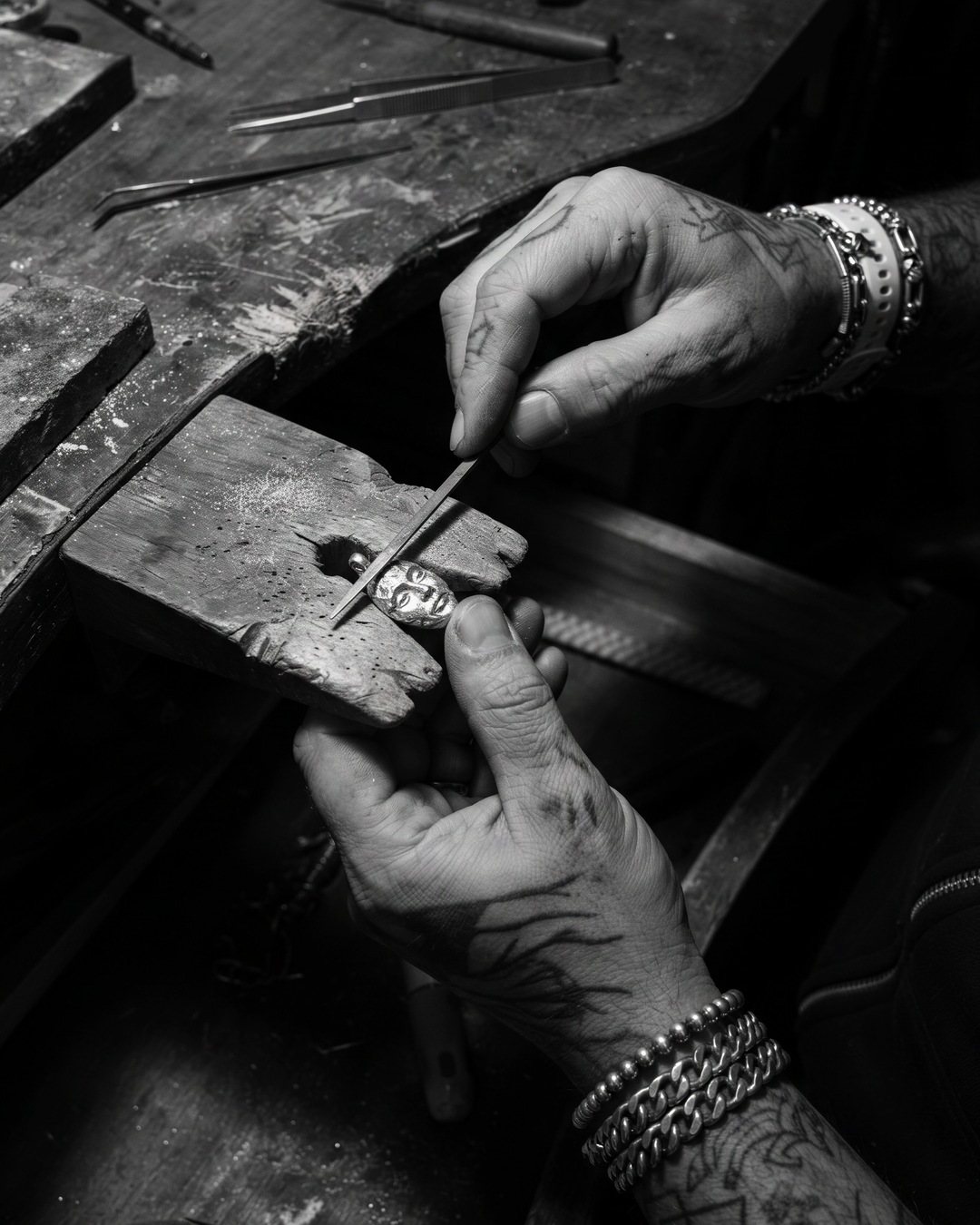
In the photograph the hands hold a small silver face against the pin, the file working along its cheek. The fingers are close to the blade, closer than seems safe, because only from there can the hand feel how much the metal gives. Jewellers' hands carry the history of this closeness: small scars, hardened fingertips, nails worn short by the edge of the pin.
No machine works like that. A machine removes metal evenly. A hand removes it with intention, a little more here, a little less there, guided by the eye and by something harder to name. That difference is the reason a hand-filed face never looks like a copy of another.