Journal 04 · Process
From wax to silver
Many of our figures are not born in silver. They are born in wax — a hard, dense, slightly greasy material that can be carved, scraped and polished like soft stone. Silver arrives later, and when it does, the wax is gone for ever. This is one of the oldest ways of making metal objects: the lost-wax method. The name says everything. To get the silver, you have to lose the original.
Carving the original
Carving wax comes in blocks and tubes of different hardness. The hardest kinds hold the sharpest detail — an eyelid, the edge of a nostril, the fingers of a seated figure. Softer ones bend and forgive, good for flowing, organic forms. We work them with files, scrapers, small knives and heated needles, and the wax answers differently from metal: it clogs the file, it warms under the fingers, it shows every scratch under the lamp. A face carved in wax can take an evening or a week.
At this stage the piece is fragile and very light. It is easy to change: a cheek can be lowered, a chin cut away, a nose built up with a drop of melted wax. This freedom is the reason we sculpt in wax at all. Silver resists. Wax listens.
The disappearance
When the wax figure is finished, a small wax rod — the sprue — is attached to it: it will become the channel through which metal flows in. The figure is set in a steel cylinder and surrounded with a liquid plaster-like investment that hardens around it, filling every hollow and capturing every mark.
Then comes the strangest part. The cylinder goes into a kiln and is heated slowly, over many hours: first gently, to dry it, then gradually up to around 730 °C. The wax melts, runs out and burns away completely. If the heat rises too fast, the wax boils inside and ruins the surface; if the temperature climbs too high, the investment itself starts to break down. When the process is right, what remains inside is an empty space in the exact shape of the figure. The original no longer exists. Only its absence does.
To get the silver, you have to lose the original.Pouring
The mould is cooled to a casting temperature of roughly 480–540 °C and left to settle so its centre is as warm as its walls. Sterling silver starts to melt at about 802 °C and is fully liquid only at around 893 °C; it is heated beyond that, in a crucible, under a soft flame that protects it from the air. Then, in a few seconds, it is poured or spun into the empty space. The metal takes the place of the wax, line for line, mark for mark.
After cooling, the investment is broken and washed away, and a raw, dark, rough silver figure appears, still attached to its channel. It is soft at this point — roughly as soft as annealed silver — and looks almost nothing like a finished piece.
Where the hand returns
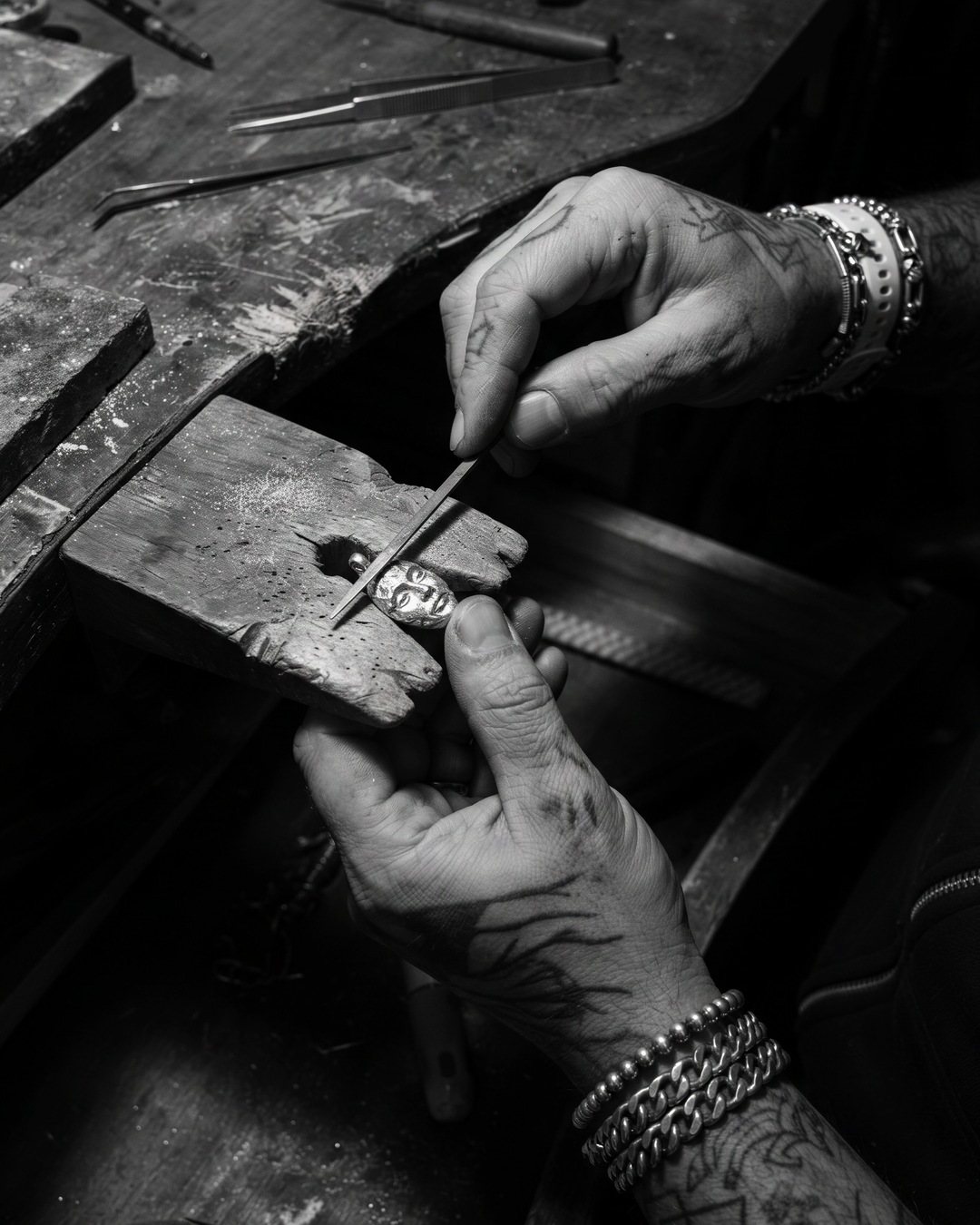
This is where many people think the work ends. For us, it begins. The channel is sawn off. The surface is filed, scraped, opened again under the lens. Details lost in the metal are recut. The silver is heated, softened, shaped, hardened under the hammer and the burnisher. Then it is darkened, and light is brought back only where it belongs. A cast is a starting point, not a product. What makes it a Dilbero piece is everything that happens after it leaves the mould.
There is a quiet philosophy in this method. The thing you carved disappears so that something more durable can take its place. A memory becomes a form, the form is lost, and the metal keeps its shape. It is perhaps the most honest description of what an object is: the trace of something that no longer exists.
All stories →