Most of the pieces you see on this site were finished at night. Not because night is romantic, but because it is quiet. The phone stops, the street stops, and what is left is the lamp, the bench and the piece.
Journal 10 · Atelier
Most of the pieces you see on this site were finished at night. Not because night is romantic, but because it is quiet. The phone stops, the street stops, and what is left is the lamp, the bench and the piece.
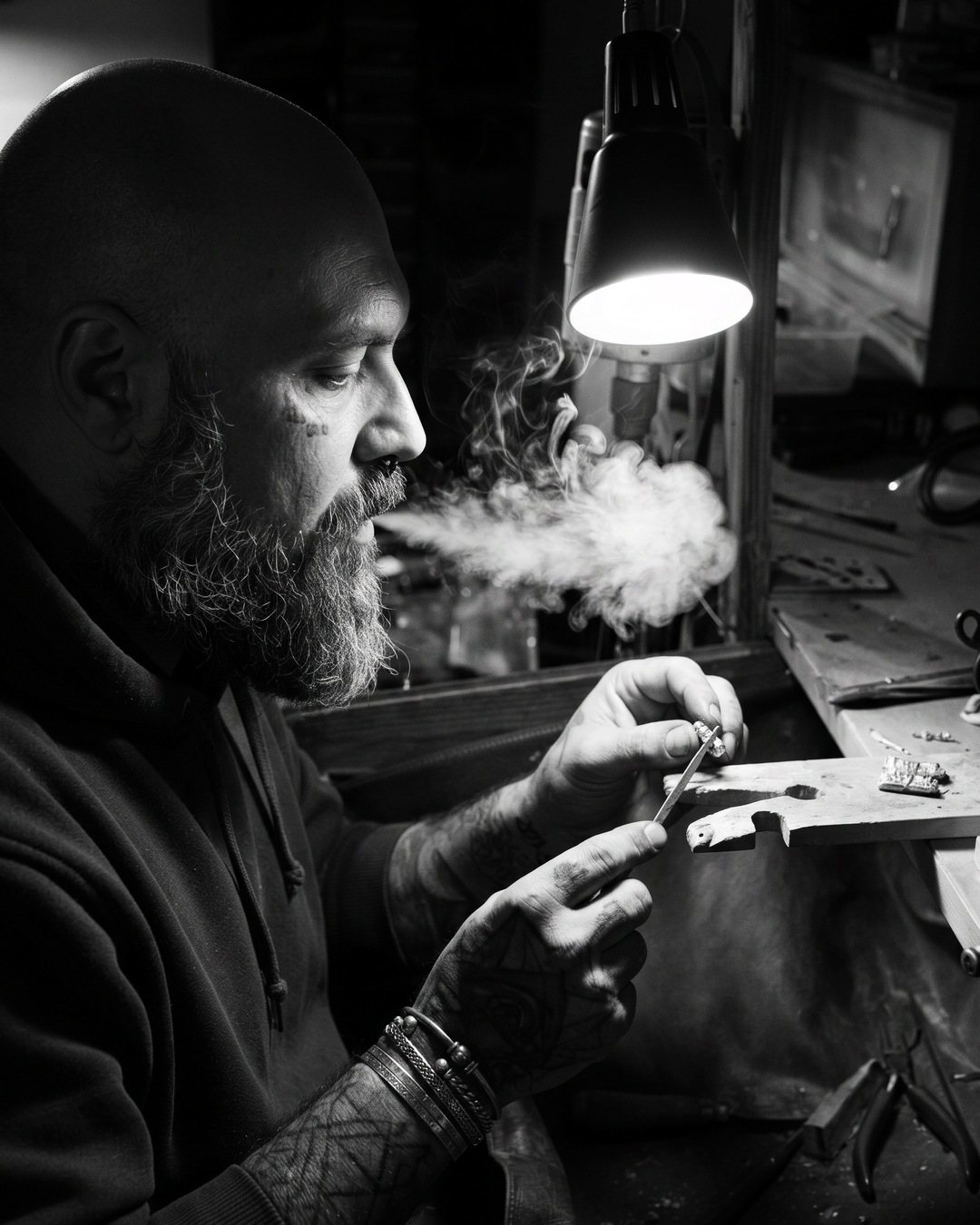
The atelier is lit by a single lamp bent low over the bench. Everything outside its circle disappears. This is not only mood. A single strong light from one side does what diffuse light cannot: it shows form. Every bump and hollow throws a shadow, every edge catches a line of brightness. Under even, flat light a sculpture looks flat. Under one lamp it becomes three-dimensional again.
It is the same light in which sculptors have looked at their work for centuries, turning a figure slowly in front of a window or a candle. It is also the light in which these pieces are later photographed — dark background, one source, the silver as the brightest thing in the frame. The way a piece is seen at the bench and the way it is shown are one and the same.
Work at the bench is not continuous. It is a rhythm of concentration and pause: a few minutes of absolute stillness under the lens, then the head lifts, the piece is held away, a breath, a look out of the dark window. The pauses are not lost time. Many decisions are made in them — whether to go further, whether to stop, whether the piece already says what it needs to say.
Some evenings produce nothing. A figure refuses to come alive, a face stays a mask, the file keeps going in the wrong direction. Those pieces go into a drawer and wait. Sometimes they come back weeks later and are finished in an hour. Sometimes they never come back. Both are part of the work.
When you hold a piece from Dilbero, you hold the result of these hours: the patience under the lamp, the decisions made in the pauses, the drawer where some pieces waited. It is not mass-produced and it was not made fast. That is not a selling point we invented. It is simply how this kind of work has always been done, by one person, at one bench, late at night.
The photograph catches a pause: the head turned to the side, breath in the lamp's light, the small piece still between the fingers. A second later the lenses will go down again and the night will continue.