Journal 01 · The body
Naked, not nude
There are two ways to be without clothes, and art has spent three thousand years moving between them. One is to be naked: exposed, caught, particular, a body that did not choose to be seen. The other is to be nude: a body that has been looked at for so long, by so many hands and eyes, that it has turned into a form. The naked body belongs to a person. The nude belongs to everyone.
Our small torsos live exactly on that border. They began as a question we kept asking at the bench: what is left of a body when you take away everything that tells a story — the face, the hands, the gesture — and keep only the weight?
The oldest subject
The first human figures ever carved were not gods or kings. They were bodies, mostly women, small enough to hold in one hand. Some of them are around thirty thousand years old. They have no feet to stand on and almost no faces. Their carvers did not care who the woman was. They cared about the volume: the belly, the hips, the breasts, the places where life is made and carried. These figures were meant to be held, turned, carried in a pocket or a bag. They were, in a sense, the first jewellery.
We find it moving that the oldest art is also the most intimate object. Not a monument for a square, but a weight for the palm. A torso pendant is a distant relative of those figures: a body reduced to the size of a thumb, made to travel with a person and to be touched without thinking.
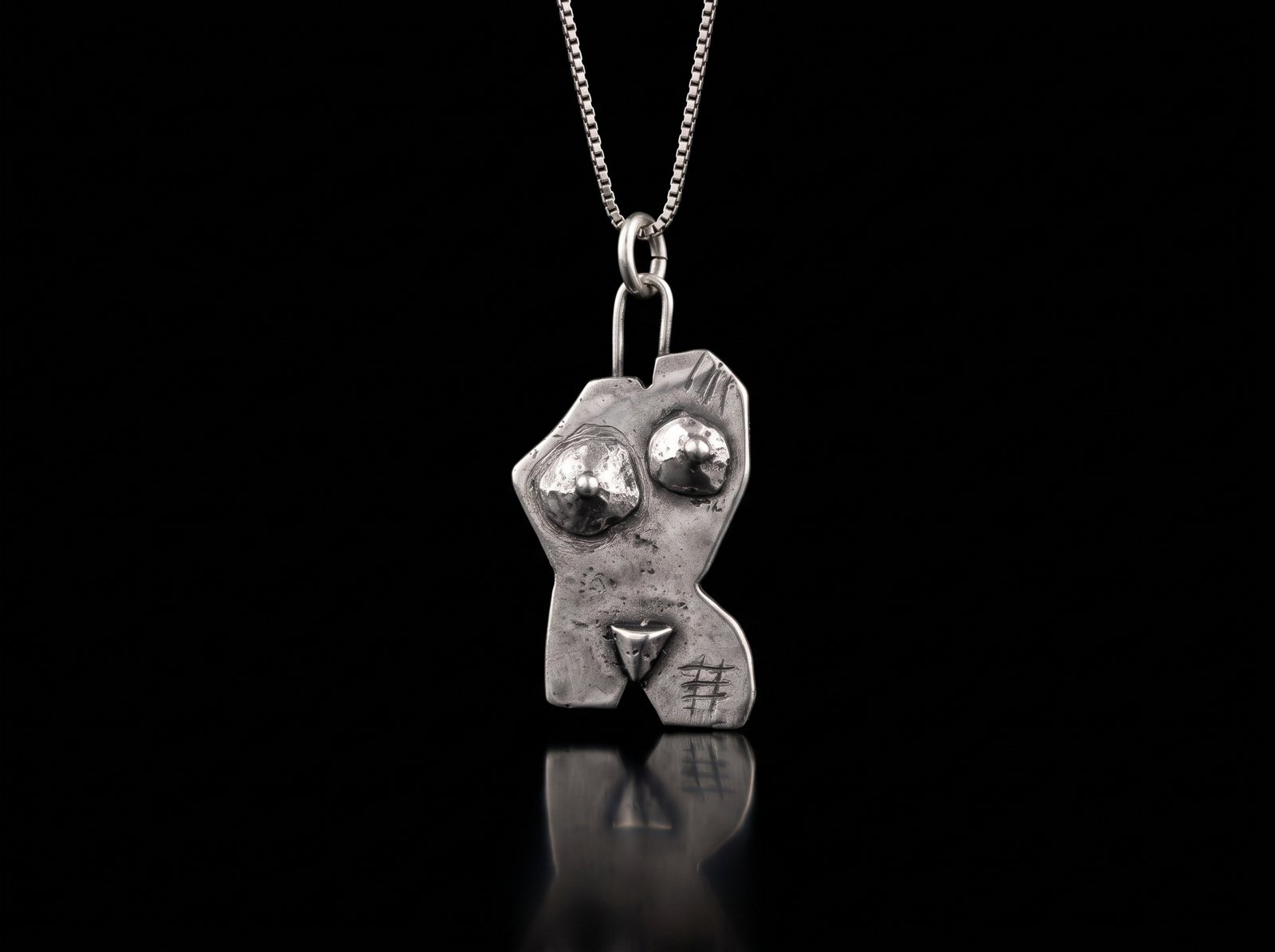 Plate — Torso
How the body learned to stand
For a long time sculpted bodies stood like columns: both feet on the ground, arms at the sides, eyes forward. Then something small happened that changed everything. The weight moved onto one leg. One hip rose, the opposite shoulder dropped, the spine curved gently in answer. Art historians call it contrapposto. We call it the moment the stone started to breathe.
That shift is the reason a body looks alive even when it does not move. It is a pause between two steps, a decision held in suspension. When we shape a torso, this is the line we look for first — not the outline, but the line of weight running through it. A torso without that line is an object. With it, it becomes a person resting.
For centuries the female nude was rare in sculpture; women were carved clothed, the cloth wet and clinging, revealing and hiding at once. When the first life-size nude goddess was finally carved, people travelled across the sea to see her, while another city refused her and chose a clothed version instead. The nude has always carried that charge: admiration and unease in the same glance.
The fragment
Walk through any museum of antiquity and you will meet more fragments than whole bodies. Heads without bodies, bodies without heads, a hand holding nothing. Time has edited them. Arms broke where they were thinnest, noses wore away, gestures disappeared. What survived is the core: chest, belly, hips, the mass that carried everything else.
Some of the greatest artists in history stood in front of such broken torsos and refused to see them as damaged. They saw them as complete. Later, sculptors began to make fragments on purpose — a walking figure without arms, a body without a head — because they understood what time had already shown: a fragment does not hide what is missing. It concentrates what is there.
A fragment is not an unfinished body. It is a body that has survived.Our torsos are fragments by choice. No head, so they cannot look back at you or tell you who they were. No hands, so they cannot cover themselves, point or explain. They are only presence. The eye goes where it should: to the volume, the curve, the small asymmetries that make one body different from every other.
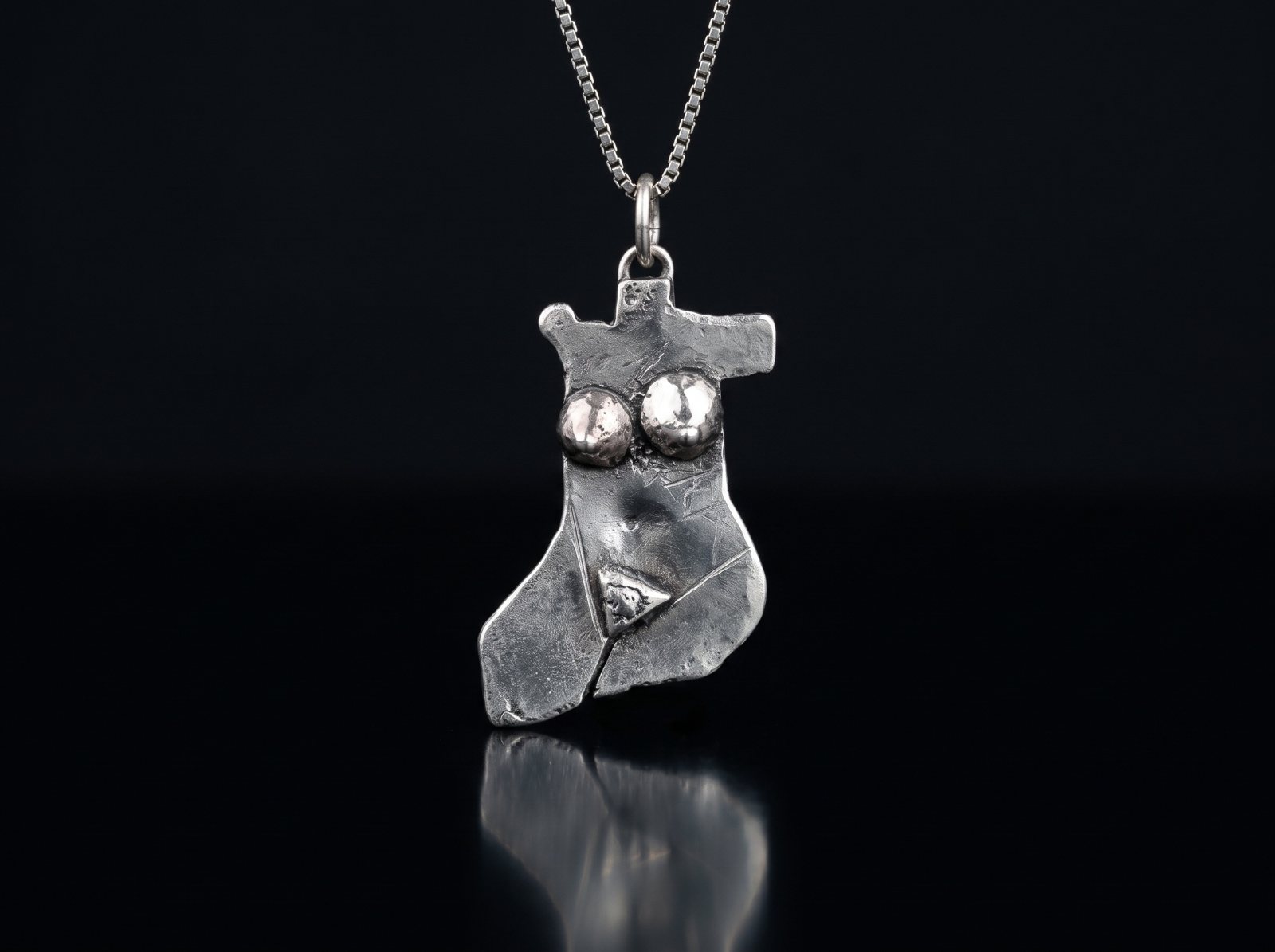 Plate — Venus
From skin to silver
A torso begins with the memory of a body — never one model, always several bodies merged into one. Then that memory has to be pushed into three dimensions and shrunk. This is the hardest part. A body thirty millimetres tall has no room for detail; every decision becomes structural. A breast is not drawn, it is a volume that has to catch light from one side and fall into shadow on the other. A hip is not a line, it is a turn of the surface.
Silver is a strange material for a body. It is cold when you pick it up and warm a minute later. It is hard, yet it remembers every touch of the file. We work it by hand until the surface stops looking polished and starts looking lived in — small dents, uneven planes. Perfect symmetry would make it a trophy. The small errors make it a body.
Then the silver is darkened. The black settles into every hollow, and light is brought back only to the high points — the shoulders, the breasts, the curve of the belly. It is the same thing that happens to bronze statues that people have touched for centuries: the parts that are touched most become bright. On a torso pendant, the wearer finishes this work. Months of skin and cloth polish the high points further, and the body slowly draws itself.
A body worn on a body
Hang a torso on a chain and something unexpected happens. It lies on the sternum, between the collarbones, exactly where a hand goes when someone is moved or afraid. It rises and falls with the breath. It takes the temperature of the person wearing it. The nude, the idealised form, the museum object, becomes naked again — close, private, specific.
That is the circle we are interested in. A real body is turned into an ideal form, the ideal form is turned into an object, and the object returns to a real body and starts living its life. It is not decoration. It is a small sculpture that agrees to be carried.
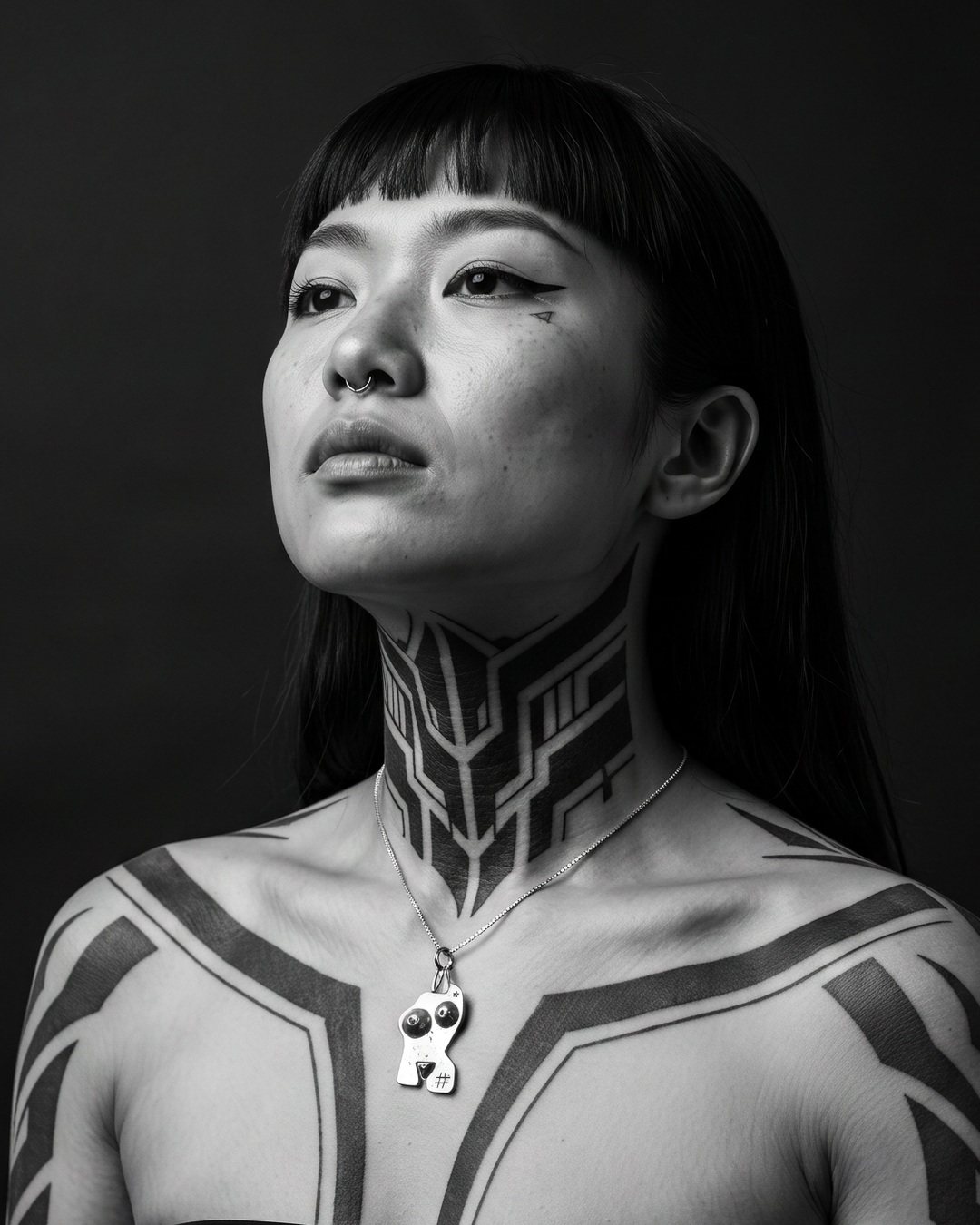
The tattoos on the woman in the photograph were drawn for the piece: black bands that open from the collarbones and frame the chest like the broken edges of an ancient statue. The silver body and the drawn body answer each other. One is carried on the skin, the other is written into it.
Plate — TorsoAll stories →