Every piece we make carries a small number: 925. It is not a serial number or a date. It is a measure of truth. It says that out of every thousand parts of the metal, nine hundred and twenty-five are pure silver.
Journal 03 · Material
Every piece we make carries a small number: 925. It is not a serial number or a date. It is a measure of truth. It says that out of every thousand parts of the metal, nine hundred and twenty-five are pure silver.
Pure silver — 999 — is beautiful and almost useless for jewellery. It is so soft that a ring would lose its shape on the finger and a pendant would scratch at the first touch. For centuries silversmiths solved this the same way: by adding a little copper. Seven and a half parts in a hundred are enough to give silver backbone without taking away its colour. That alloy has a name older than most countries: sterling.
Other standards exist, and each carries its own history. Britannia silver, 958, was once compulsory in England. Much old European silver is 800 or 835; Scandinavian pieces are often 830; coins were frequently 900. We work only in 925, because it is the balance we believe in: hard enough to live on a body for decades, soft enough to keep every mark of the hand.
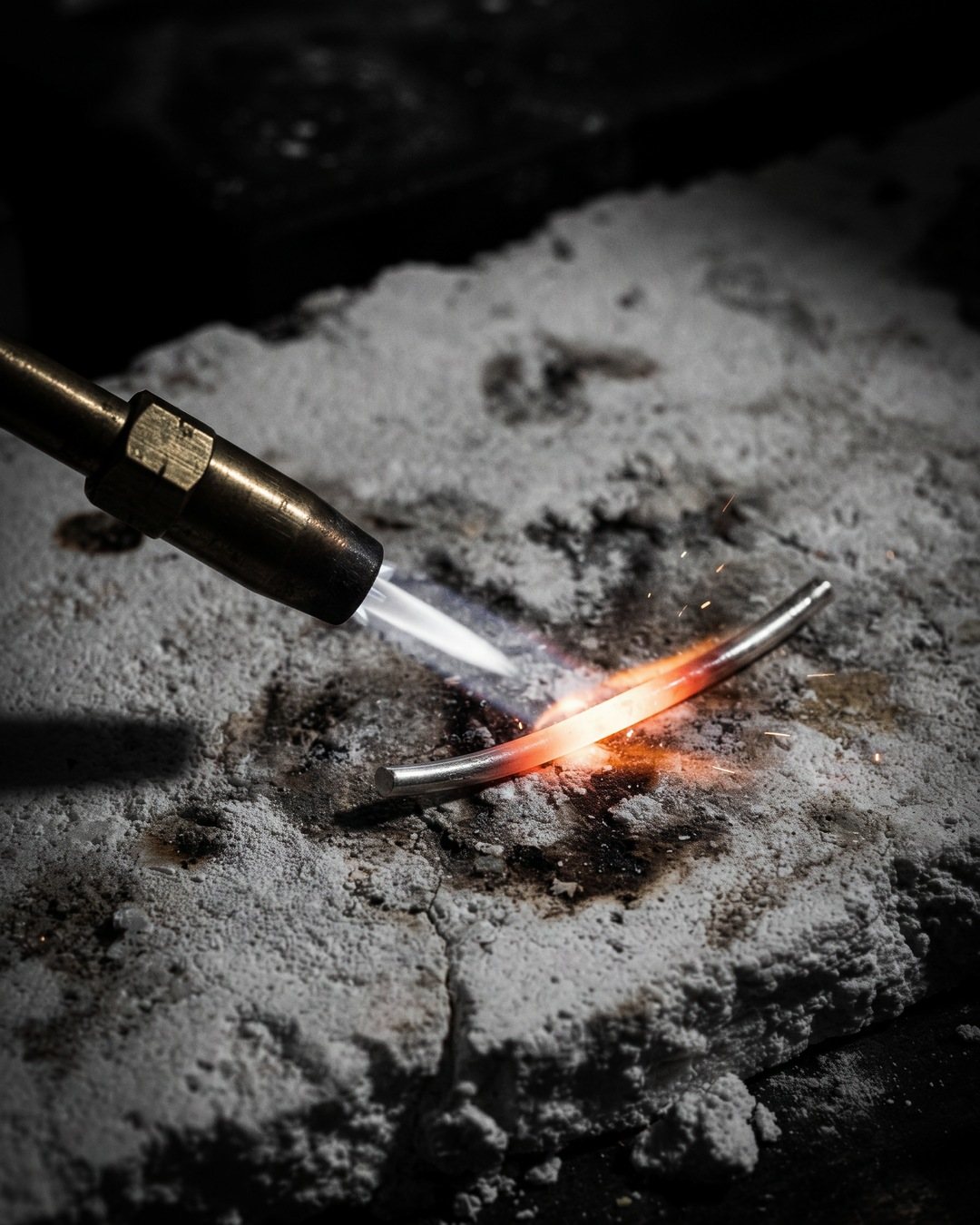
Pure silver melts at one exact point, 961.8 °C. Sterling does not. Because it is a mixture, it melts across a range: it begins to soften and sweat at around 802 °C and becomes completely liquid only near 893 °C. Between those two temperatures the metal is neither solid nor liquid. Working with fire means knowing that zone well, because a thin part of a figure can slip into it while the thicker body is still safe.
Silver changes its character with what you do to it. Freshly softened, sterling is gentle — about 60 on the hardness scale. Every blow of a hammer, every bend, every pass of a rolling mill packs its crystals tighter; worked hard, it can triple in hardness and become springy, then brittle. Fire undoes this: heated to a dull pink glow, around 650 °C, and quickly plunged into water, the metal relaxes and becomes soft again.
There is another, slower way to harden it, almost like aging. The silver is heated high, near 750 °C, plunged into water, and then held for an hour at a modest 300 °C. In that hour, invisible particles of copper gather inside the structure and lock it. The metal comes out twice as hard as before. Rapid cold softens; patient warmth strengthens. It is hard not to see something human in that.
The copper that gives silver its strength also gives it a weakness. In the flame, oxygen slips beneath the surface and darkens the copper into a stain that no acid will remove: firescale, a faint purple shadow inside the metal. Jewellers protect against it with gentle flames, flux and charcoal, or bring a thin skin of almost pure silver to the surface by heating and pickling again and again. Copper is also why silver darkens with time — and why we choose to darken it ourselves.
925 is therefore not only a standard. It is a compromise between purity and life, between the ideal metal and the one that can actually be worn. Every piece we make lives inside that compromise. So do the people who wear them.