Journal 05 · Atelier
The bench
Every jeweller's life happens at one table. Not a desk, not a workbench like a carpenter's, but a strange piece of furniture that has barely changed in two hundred years: a heavy wooden top with a half-moon cut out of its front edge, a small wedge of wood sticking out from the middle of that curve, and something hanging underneath to catch what falls.
Why the bench is cut
The curved cut-out looks decorative. It is not. It lets the body move closer, so that the arms rest on the wood on both sides and the work sits right in front of the chest. Old goldsmiths' benches often had several of these half-moons along one long table, one for each worker, so that a whole family or workshop could sit shoulder to shoulder at the same piece of wood.
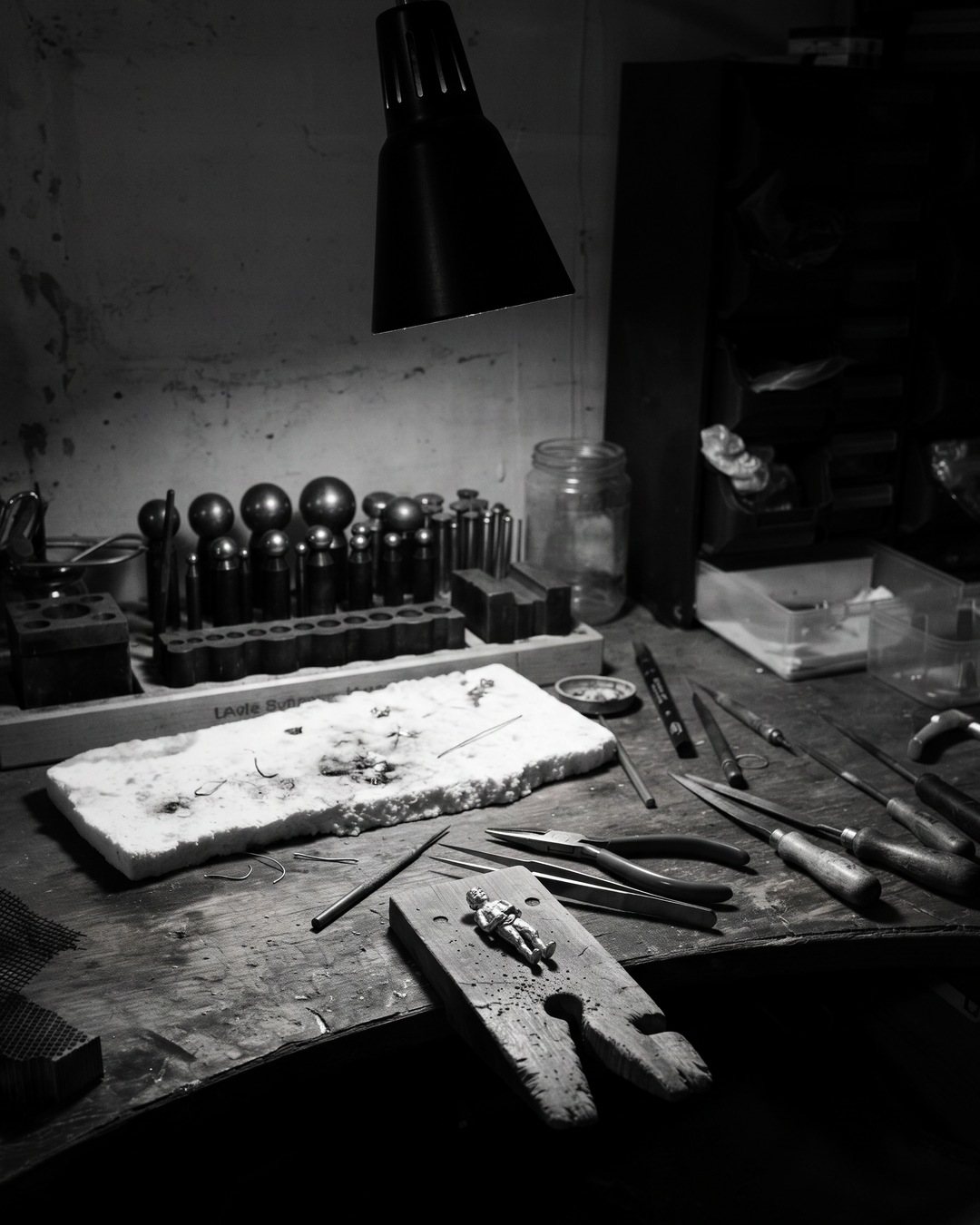
In the middle of the curve sits the bench pin: a small block of hardwood, cut and filed again and again until it takes the shape the hands need. It is the most important tool on the bench and also the cheapest. Almost everything is held against it: a piece being sawn, a figure being filed, a ring being polished. After some years it is full of notches and grooves, a map of every piece that passed over it. Ours is no exception. No two jewellers' pins look the same.
The height of the hands
A jeweller's bench is much higher than an ordinary table. The pin should sit roughly at the height of the chest, so that the work is close to the eyes without bending the neck, and the forearms can rest while the fingers move. When the height is wrong you feel it after an hour in the shoulders and after a year in the spine. Most jewellers adjust the chair first, then raise or lower the pin, until the elbows lie flat on the wood and the back stays straight.
What falls is kept
Under the cut-out hangs a tray or, in older benches, a leather skin stretched like a hammock. Its job is simple and serious: to catch every grain of silver that falls from the saw, the file or the fingers. Over weeks these filings become a small pile of grey dust, and that dust is precious metal. It is collected, cleaned and given back to the cycle. Nothing that comes off a piece is wasted. The leather also catches the small things that slip from the fingers — a figure, a ring, a pin — which otherwise would disappear on the floor forever.
A bench is not furniture. It is the shape of a way of working.The bench in the photograph is an ordinary one, scarred and stained, with a white board for the flame, rows of punches and the tools of the last evening still lying where they were put down. It is never tidy for long. The order is not in how it looks, but in where every hand goes without looking.
All stories →