Journal 02 · Faces
The face without a name
A portrait wants to be recognised. A mask wants the opposite. A portrait says: this is that person, on that day, at that age. A mask removes the person and leaves only the structure every face is built on — two hollows for the eyes, a ridge for the nose, an opening that may or may not speak.
Our faces are masks in that sense. They are not portraits of anyone. Nobody sat for them, and nobody would recognise themselves in them. And yet people often tell us that a face reminds them of someone. That is exactly the point.
Why the mask is older than the portrait
Long before people painted portraits, they made masks. Masks for the dead, masks for ritual, masks for the theatre, masks that allowed one person to become someone else for a night. In many cultures the mask was not a disguise but a doorway: the wearer stopped being himself and became the spirit, the ancestor, the character.
What all those masks share is reduction. A mask never shows everything. It chooses: an enormous nose, closed eyes, a mouth pulled into a line. Out of all the information a face carries, it keeps the one or two things that matter and exaggerates them until they become a sign. That is why a mask can be read from far away, across a fire or a stage.
A mask does not hide a face. It shows what every face is hiding.Shaping a face that belongs to no one
A face at the size of a pendant has almost no room. There is no space for eyelashes or wrinkles; everything has to be said with planes and edges. A nose is a ridge that catches light. An eye is a hollow that holds shadow. A mouth is a single cut, and the angle of that cut decides whether the face is tired, angry or calm.
We work these faces by pressing in and taking back. A cheek is raised, then flattened. A nose is pushed to one side and left there. Symmetry is avoided the way a lie is avoided: no living face is even, and a perfectly symmetrical face looks dead. The small imbalances — one eye lower, the mouth slightly turned — are what make the silver feel like someone is inside it.
Under the lens, at high magnification, a face becomes a landscape: ridges, erosion, a dry riverbed where the tool passed. At arm's length it becomes a person again. The work happens in the distance between those two views, moving the piece back and forth until both of them are true.
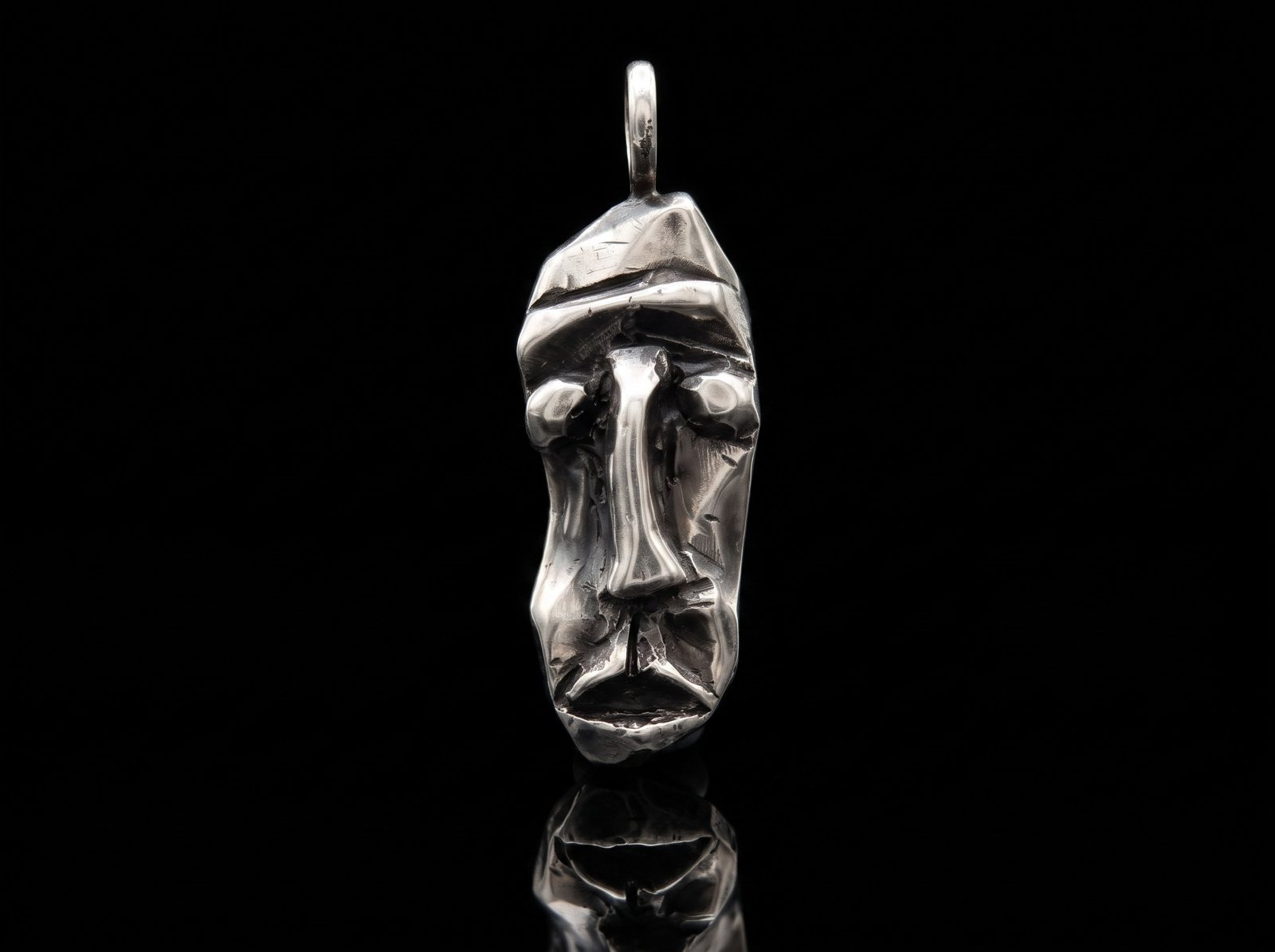 Plate — Mask
Where the faces come from
They arrive half-remembered. Someone seen on a train who looked too long out of the window. A saint on an old fresco, the paint cracked across his cheek. A stranger at a bar. A face in a dream that disappears in the morning. None of them is copied. They are mixed, simplified, and pushed towards the mask until the individual disappears and only the expression remains.
A face is finished when it stops looking like the face we planned and starts looking like someone we have met.
Wearing a face
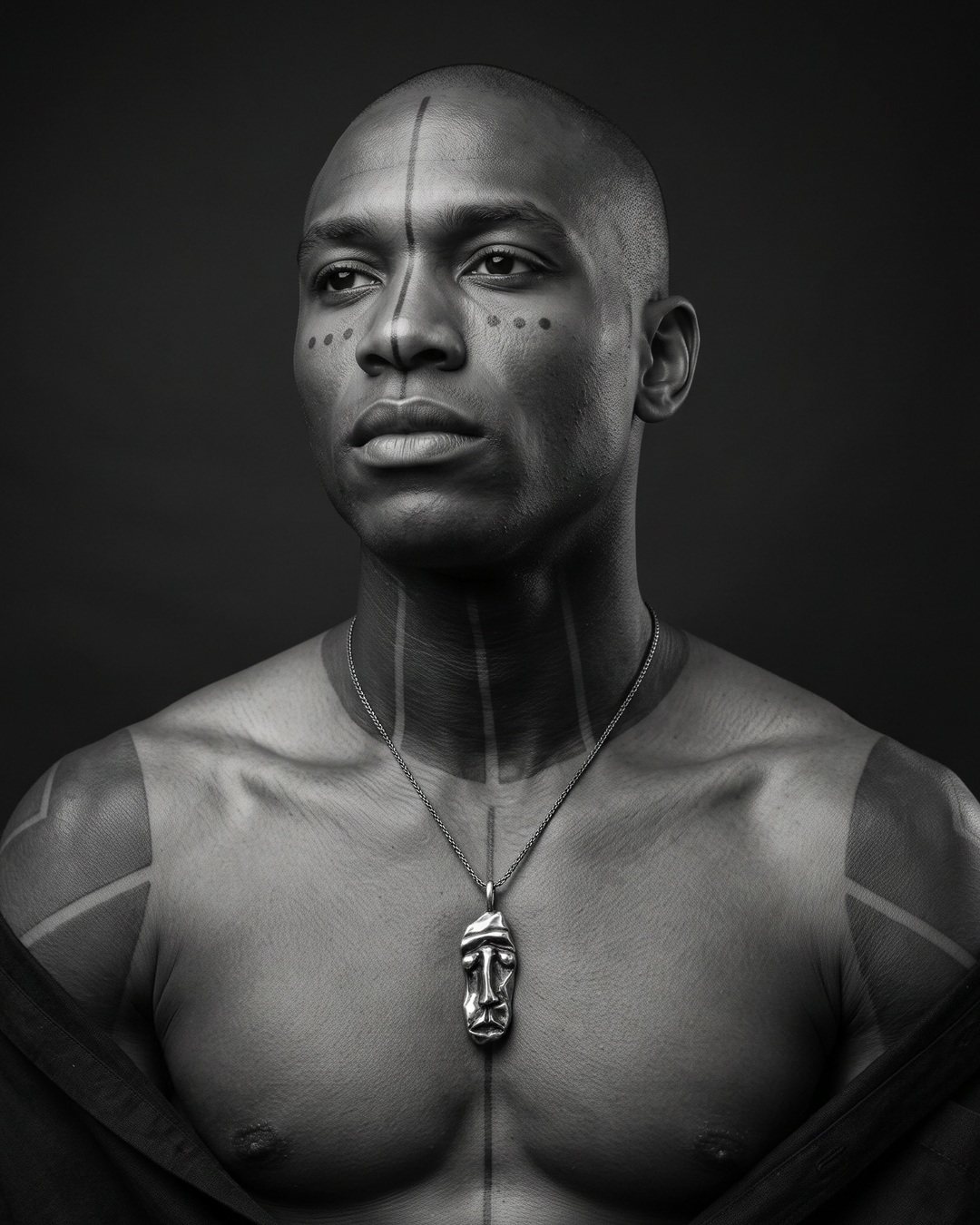
There is something strange about wearing a face on your chest. It is a second presence, a small silent witness that goes everywhere with you. People touch it without noticing, the way you touch a coin in your pocket. Over time the high points — the nose, the brow, the cheekbones — become brighter from that touch, while the hollows stay dark. The face slowly gets its own history.
The man in the photograph carries a line drawn from his forehead down over his nose: the same ridge that runs down the silver mask. The face on the skin and the face in silver look in the same direction. One of them has a name. The other never will.
Plate — MaskAll stories →