Journal 18 · Atelier
The saw
The jeweller's saw looks fragile: a light metal frame holding a blade as thin as a hair. Yet much of jewellery begins with it. Every outline cut from a sheet of silver, every opening pierced inside a shape, every clean separation of one part from another passes through this blade.
A blade like a thread
Saw blades for jewellery come in many sizes, from very coarse ones with few teeth to blades so fine that they can barely be seen. Finer blades cut slowly and leave a clean line; coarser ones cut faster through thicker metal. A good rule is that at least two or three teeth should always touch the silver at once. Fewer, and the blade catches and snaps.
The blade is stretched tight in the frame, teeth pointing down towards the handle, so that it cuts on the downward stroke. Tension matters. A loose blade wanders and breaks; a tight one sings a little when plucked. Many jewellers run the blade across a block of beeswax before sawing, so it moves smoothly through the metal.
Cutting on the pin
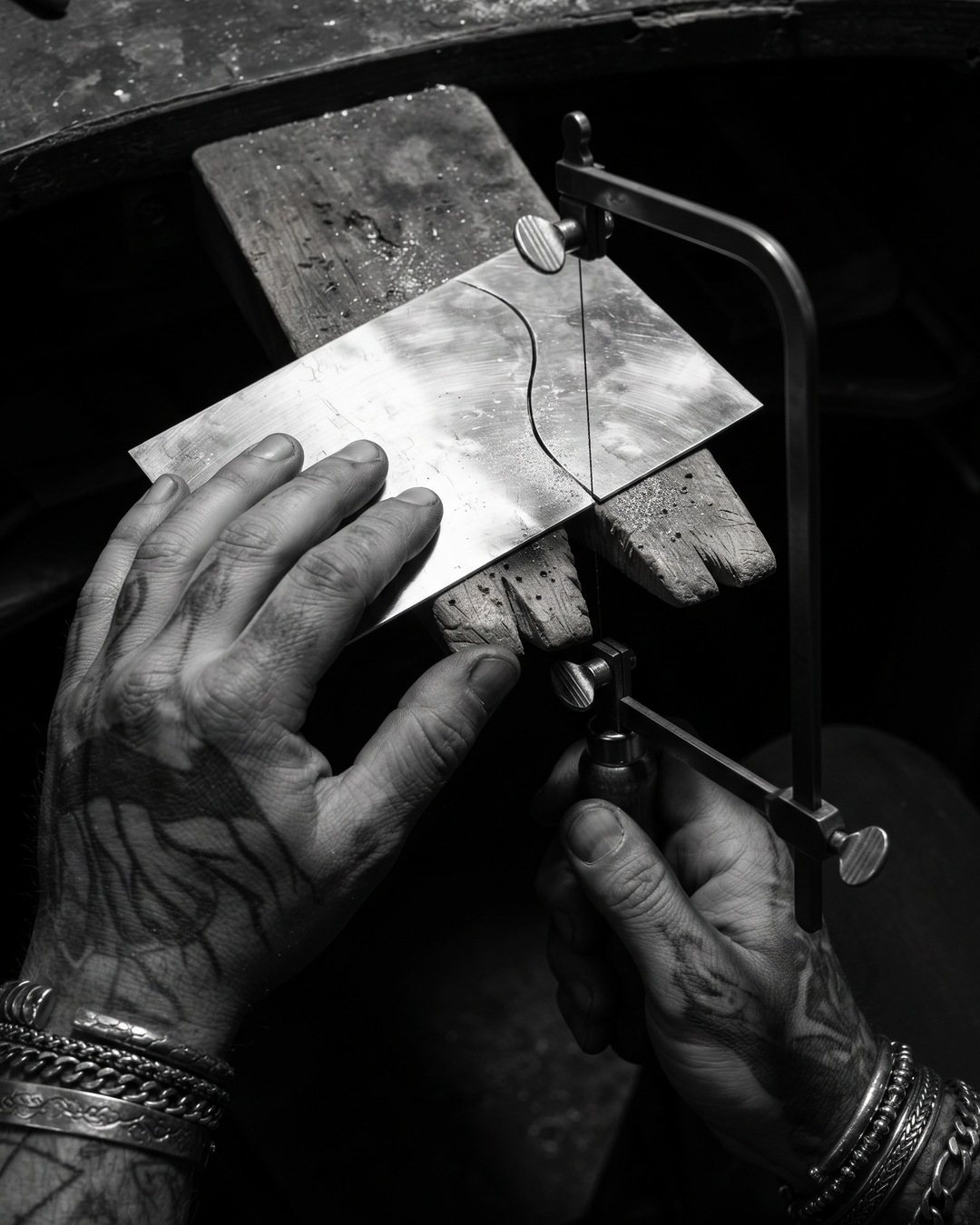
The silver rests on the bench pin, over the V-shaped notch, and is held flat with the free hand. The saw moves straight up and down, in long, even strokes, using the whole length of the blade. The cut is not pushed forward; it is allowed to advance on its own. To turn a corner, the saw keeps moving up and down while the hand slowly rotates the metal, not the other way round.
To cut a shape inside a sheet — an eye in a face, a window in a wall — a tiny hole is drilled first, the blade is threaded through it and fixed in the frame again. Then the shape is cut from the inside out. It is slow, patient work, and the reason some of our pieces take far longer than their size suggests.
A good cut is not fast. It is the one that never has to be corrected.Broken blades
Every jeweller breaks blades — many of them. They snap when the hand twists, when the saw is forced, when attention drifts for a second. A broken blade is a small lesson about impatience. Experienced hands break fewer, but never none. Short pieces of broken blades are often kept and used again, because the frame can be shortened to hold them.
In the photograph the saw is halfway through a sheet of silver. A thin line of dust falls below it into the drawer. That dust, too, will be collected. Nothing that leaves the silver is wasted.
All stories →